
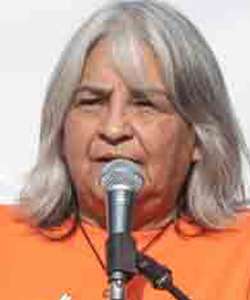


Excerpts from their written contribution to the book Did You See Us? – Reunion, Remembrance, and Reclamation at an Urban Residential School:
“A lot of residential school Survivors remember their numbers. We all had a number. I don’t know what my number was, but my number was on all my clothes and the bed that I slept in, but I don’t know what it was.”
“There was no such thing as a phone. So once in a while I would write a letter to my mom. I don’t remember ever receiving a letter back, a reply from her. And, so, that’s how it was. We were always lonesome. We took others as our sisters, our brothers, but mainly our sisters.”
“The only time we had a good time as when – I don’t know how often, maybe once a month or maybe less than that – we would have a dance in the gym. There we would be together with the boys and have fun and dance, but, other than that, we all had to stay separate.”
“And you know, these are the things that they’re talking about, the intergenerational effects of Indian residential schools. Because I didn’t know how to parent, and I didn’t know how to deal with certain stuff with my children. Even though I told them after a while that I loved them, I couldn’t keep them. I couldn’t go to them.”
“These are the things that are happening that we have to deal with day in and day out in our homes, in our community, and in ourselves – within myself too. I thought, “I’ve done a lot of healing. I healed enough.” No, no. Something keeps coming up almost every day. Almost every day, something will trigger, “No, you’re not okay. You’re just strong. You’re just patient.””
“They’re asking us, “How can we deal with reconciliation? What can we do to build that bridge?” I said, “Start dialoguing, with anybody; with any Anishinaabe person you see, sit down with them.” First, they’ll cry, because they have to release it; and then they’ll start to tell you their experience. That’s how it’s going to be. That’s the only way.”
“But it was so lonely because, as I told them in there, there was no communication with my mom and dad, and my siblings when I left. There was no such thing as a phone. So once in a while I would write a letter to my mom. I don’t remember ever receiving a letter back, a reply from her.”